Showing posts with label Angels. Show all posts

Saturday, October 14, 2017

October 12 -- Adult Ed Course on the Angels, Session 2: Angels at their creation and fall

Session 2 of our adult ed series on the angels


Objectives for Session 2: Angels at their creation and fall
1) Review what follows from the fact that angels are immaterial, pure spiritual beings
2) Consider the ways in which an angel, though perfect in himself, could possibly fall

3) Consider the wonderful obedience of the good angels


Monday, April 8, 2013

What troubled the Virgin at the Annunciation, and what we learn


April 8th, Feast of the Annunciation
On account of March 25th falling during Holy Week this year, the Church celebrates the Annunciation of the Blessed Virgin Mary on the Monday after Easter Week, which is today. The Solemnity of the Annunciation commemorates the moment in which our Savior became man – and in this sense it is the feast of the Incarnation.
It was a the Annunciation that the Word became flesh and dwelt among us. It was in this moment that God became man so that men might share in the life of God.
And yet, though this occasion is most joyous, that Blessed Virgin was at first troubled by the Angelic Salutation. Why was she troubled? What did she fear?
Further, we ask, What are we to learn from her fear?

Monday, January 28, 2013

Why we call him "The Angelic Doctor"


January 28th, Feast of St. Thomas Aquinas
The Common Doctor, St. Thomas is often referred to as “Aquinas” after his hometown of Aquino. His most beloved title, however, is the “Angelic Doctor” – and it is this designation which inspires the greatest devotion to the saintly Dominican theologian.
Why is St. Thomas Aquinas properly called the “Angelic Doctor”, the “Angelic Thomas”, and the “Angel of the Schools”?

Friday, November 23, 2012

Is Christ the King of the angels, even in his humanity?


Solemnity of Christ the King
For in [Christ] dwells all the fullness of the Godhead corporeally. And you are filled in him, who is the head of all principality and power. (Colossians 2:9-10)
It is clear enough that, in his divinity, our Savior is head of both angels and men, for the reign of God extends to every creature. It was through the eternal Word that all things were made, and therefore we may well attribute divine authority and kingship to the Second Person of the Blessed Trinity.
However, we may well ask whether, as man, Jesus is rightly called the King of the Angels. The angels were not created through the humanity of Christ, nor (it seems) were they redeemed through his sacred humanity – for he became man in order to save men, but the good angels were already saved.
Therefore, on the Solemnity of Christ the King, we ask whether Christ is the King of the angels in his humanity.

Wednesday, October 24, 2012

Did St. Raphael lie when he said, "I am Azarias"?


October 24th, Feast of St. Raphael (traditional calendar)
And Raphael the angel answered: I am Azarias the son of the great Ananias. (Tobit 5:17,18)
There are three angels mentioned by name in the Canonical Scriptures – Michael, Gabriel, and Raphael. The last of these is explicitly present only in the book of Tobit, while Michael is reference in three books (Daniel, Jude, and Revelation) and Gabriel in two (Daniel and Luke).
While all the archangels (named and un-named) are celebrated on September 29th in the post-Vatican II Liturgy, St. Raphael has traditionally been commemorated on October 24th.
We do well to consider today not only the significance of Raphael’s name and his role in the Scriptures, but also the difficult question of whether he told a falsehood when he presented himself as Azarias the son of the great Ananias.

Tuesday, October 2, 2012

Can my guardian angel read my mind?


October 2nd, Feast of the Guardian Angels
For he hath given his angels charge over thee; to keep thee in all thy ways (Psalm 90:11)
“From its beginning until death, human life is surrounded by their watchful care and intercession. ‘Beside each believer stands an angel as protector and shepherd leading him to life.’ Already here on earth the Christian life shares by faith in the blessed company of angels and men united in God.” (CCC 336)
A plethora of questions may well be asked about guardian angels. We have attempted to discuss some of these in a previous article [here].
However, we did neglect to answer one question which is probably most common: Can my guardian angel (or any angel, for that matter) know the secret thoughts of my soul? Does my angel know everything I am thinking? Co-relatively, Does Satan or any of the demons know all that passes within my soul?
Our answer will be derived mostly from the Angelic Thomas, Summa Theologica I, q.57 [here] and q.111 [here].

Sunday, December 18, 2011

Why did God send Gabriel for the Annunciation?


4th Sunday of Advent, Luke 1:26-38
The angel Gabriel was sent from God to a town of Galilee called Nazareth, to a virgin betrothed to a man named Joseph, of the house of David, and the virgin’s name was Mary.
Familiar as we are with the narrative of St. Luke’s Gospel, we are tempted to take it for granted that God sent the archangel Gabriel to announce the joyful news of the Incarnation to the Most Blessed Virgin Mary.
Yet, of course, it did not need to have happened that way. God could have forgone the Annunciation all together. Or one of the Persons of the Trinity could have appeared to Mary rather than sending an angel. Further, even granting that God chose to send an angel – he could have sent a seraphim rather than an archangel, or he could have sent Michael rather than Gabriel.
Why then did God choose to send an archangel? And why did he send Gabriel?

Thursday, September 29, 2011

Where are the archangels among the choirs of angels?


September 29th, Feast of the Archangels
Sts. Michael, Gabriel, and Raphael are the only three angels mentioned by name in the Scriptures, and they all belong to the same choir of angels: The archangels.
From St. Dionysius and St. Gregory the Great, we learn that there are nine choirs of angels which are gathered into three sets of three. But where are the archangels in this list? Are they toward the top of the bottom? The answer may surprise you!

Thursday, February 17, 2011

Questions (and answers) on early Genesis, Part II


As, for the past two weeks, the daily Mass readings in the Novus Ordo have presented the Church with the first eleven chapters of Genesis (from the creation to Abraham), it seemed fitting that we should briefly consider several questions which may arise in the minds of believers who read these passages. There are certainly many fascinating events and stories, and there are many thousands of questions which could be raised, but we are here attempting only to raise a few which seem most profitable and most interesting to us.
In the first part of our little “commentary,” we discussed the six days of creation, the serpent-tempter, the mark of Cain, and the long life-spans of the early Patriarchs. Now, in the second part, we discuss the period before, during and after the great flood. Again, we here intend to give only an answer, not the answer – for surely, in such difficult questions as these, there is room for much diversity of opinion.
It would be most beneficial if we all took the time to re-read these eleven chapters, especially if we have not read them recently (in the past couple of months).

Thursday, January 6, 2011

Bethlehem star not really a star, some experts say


The Epiphany of the Lord, Matthew 2:1-12
And behold, the star that they had seen at its rising preceded them, until it came and stopped over the place where the child was. They were overjoyed at seeing the star.
Having discussed the chronology of the infancy narratives as well as the particular question regarding the time in which the star appeared to the Magi (and, therefore, the length of their travel to Bethlehem), we now turn to the nature of the star itself. As we read the biblical account, it becomes clear that this is no ordinary star. It went before the Magi to guide them, it stopped over the place where Christ lay – something about this star allowed the Magi to recognize that it marked the birth of the Messiah.
Indeed, we are led to ponder, Was this a real star at all? While the Bible does clearly call it a “star,” must we believe that it was in fact a real star? Could it have been an angel? Or the Holy Spirit himself? Or maybe it was a meteor? Or a comet? Or was it a vision which only the Magi saw?
When we come to such a difficult scriptural question, we must turn to the experts. I do not mean that we should look to modern scientists and biblical scholars, but we must turn to the true experts – the Fathers of the Church, the Church’s venerable Doctors, and the great theologians who have interpreted the text according to the Church’s Tradition. In attempting to give something of an answer to our question, I will rely particularly on St. Thomas Aquinas and Cornelius a’ Lapide – these two theologians synthesize the varying opinions of the Church Fathers, while also taking account of the astronomical discoveries of science.

Saturday, October 2, 2010

Everything you ever wanted to know about your guardian angel

October 2nd, The Feast of the Guardian Angels
As we celebrate the feast of the guardian angels, we might become aware of the fact that we really know very little about our heavenly helpers. I am sure that most of us have many questions about our angel and how he works in the world – but where shall we ever find answers? At this point in our journey, rather than becoming discouraged or running off to many other sources, it would be best to place ourselves at the feet of the Angelic Doctor and hear what he has to tell us. The following question and answer study of the guardian angels is based on the Summa Theologica I, qq.50-64 (angels in themselves) and qq. 106-114 (angels in relation to creatures). ST I, q.113, is particularly enlightening, since it is a question devoted wholly to the guardianship of angels over human beings.

Friday, October 1, 2010

If men and women are equal, do the angels really want women to wear a veil at Mass?


October 2nd, The Feast of the Guardian Angels
Of all the scriptural passages which speak of the angels, perhaps the most confusing and difficult for our own age is the place in St. Paul’s first letter to the Corinthians in which he advises that women must wear a veil while in Church. He reasons that the man need not wear a veil, since his head is Christ; but the head of the woman is the man, therefore she must veil her head as a sign of submission. St. Paul concludes his argument with the rather surprising statement that it is “because of the angels” that the women must wear the mantilla.
In this discussion, I will care little for “political correctness”, since this could obscure the truth. Obviously, when speaking in various circumstances, I would adapt the language to fit the people; but, when discussing doctrine in a theological forum, it is necessary to write unambiguously. St. Paul has always been a great defender of the true vocation of the woman, while the feminism of our day is her great enemy!
I will first offer St. Thomas Aquinas’ commentary on the passage; then I will consider what this reference to the angels really entails…

Wednesday, September 29, 2010

If you want to understand the angels...


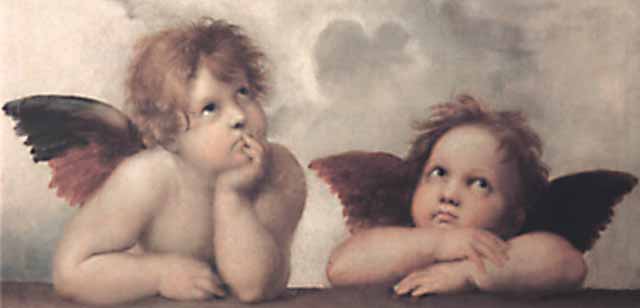
Not a helpful image for understanding angels

Angels are beings far greater than men, far exalted over men, far closer to God than men. If we are to have any hope of coming to some understanding of these marvelous creatures, we must first admit our lowliness. We must submit our reason to Revelation and to the teachings of the Fathers of the Church. Then, we must begin to think…and we must be very, very careful…

Tuesday, September 28, 2010

Why the archangels have men's names


The Archangels: Jegudiel, Gabriel, Selaphiel, Michael, Uriel, Raphael, Barachiel
Beneath: The Cherubim (blue) and Seraphim (red)

The Feast of Sts. Michael, Gabriel, and Raphael, archangels
As today is the feast of three of the holy archangels and Saturday will be the feast of all the guardian angels, I would like to make a short series of posts on the angels.
Much of what I write in the posts over the next few days will be heavily rooted in the thought of St. Thomas Aquinas – this seems particularly fitting, since he is called the Angelic Doctor. I would recommend that we all re-read his treatise on angles from the Summa Theologica I, qq.50-64, and also his discussion of the way in which the angels participate in the divine governance of the world which can be found in ST I, qq.106-114. The first of these sections discusses the angels more generally – their nature, their mode of knowing, their will, and their creation and fall. The second section deals with their relation to each other and to humanity.
ST I, qq.50-64 will answer the following questions and many more: How many angels are there? How many angels can stand on the head of a pin? Can an angel be in two places at the same time? Can an angel be in any place at all (since they are immaterial)? How do angels know things if they do not have sense experiences? Were the angels created good? How did some of the angels fall? Was Satan the greatest of the angels, before he fell?
ST I, qq.106-114 answers these and other questions: Do the angels speak to one another? Is there a hierarchy of angels? Do some angels command other angels? Do seraphim ever come to earth? Does each human being have a guardian angel? Did Christ have a guardian angel? Will the anti-Christ (presuming he is human) have a guardian angel?
I will attempt to answer some of these questions in future posts, but for now (to get the ball rolling) I would like to take a slightly lighter question: Why do the archangels have men’s names?